Maricopa Probate Court provides an online docket portal where residents and attorneys can view complete probate case histories, scheduled dates, and minute‑entry transcripts. Each filing is recorded instantly and then undergoes a 24‑hour audit that checks party names, case numbers, and document types before the entry becomes public. Users should expect minor revisions within one business day. Weekly system maintenance occurs Tuesday through Saturday from 03:00 a.m. to 04:00 a.m., during which the portal is offline for backup and security checks. Emergency patches or server upgrades are announced on the court’s notice board and by email to registered users.
The Probate and Mental Health Department manages over 20,000 active or pending cases, averaging 500 new filings each month that include estate administration, guardianship, and conservatorship for adults with dementia or schizophrenia. Judges and commissioners oversee will validation and the appointment of conservators, referencing Arizona Revised Statutes §§ 14‑1001 through 14‑1054 and recent precedent such as *In re Estate of Smith* (2023). Filing locations include four clerk‑operated counters in Phoenix, Mesa, Surprise, and Northeast Phoenix, each offering self‑service kiosks for PDF‑formatted documents and staff assistance with forms PC‑101 and PC‑203. Fees are payable by cash, credit card, or electronic check, and the clerk’s office provides an attorney‑only portal for discovery requests and electronic subpoenas.
Public Access to Probate Court Case Information – Maricota County, Arizona
Residents and attorneys can retrieve detailed probate docket data from the Maricopa County Superior Court online portal, including complete case histories, scheduled court dates, and minute‑entry transcripts for each filing. The system records each docket entry at the time of filing, then subjects the information to a 24‑hour audit that verifies party names, case numbers, and document types before the entry becomes publicly viewable. Because the audit may update or correct entries, users should anticipate minor revisions within one business day of the initial posting. System maintenance is scheduled weekly from 03:00 a.m. to 04:00 a.m. Tuesday through Saturday, during which the portal is offline for backup and security checks. Any additional outages, such as emergency patches or server upgrades, are announced on the court’s notice board and by email to registered users.
https://www.superiorcourt.maricopa.gov/docket/ProbateCourtCases/ 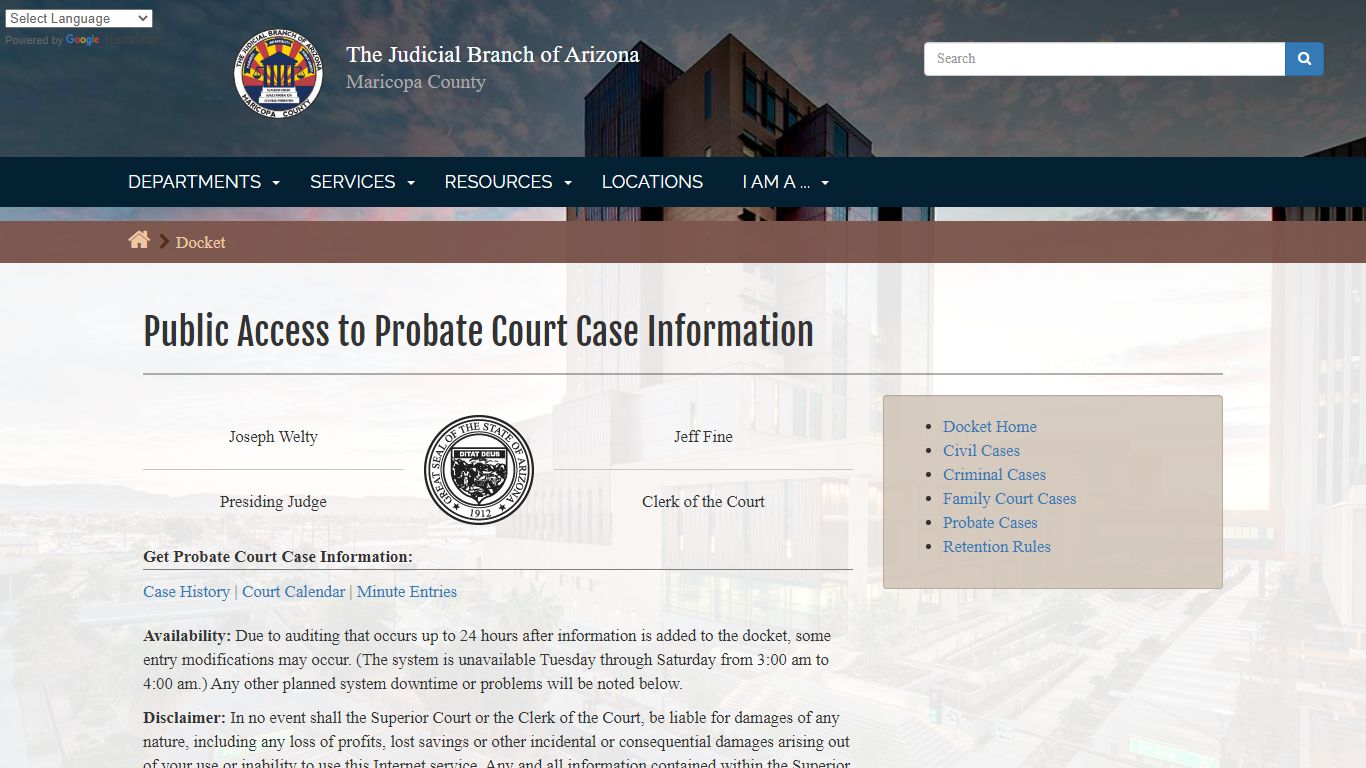
Probate and Mental Health – Maricota County, Arizona
Maricopa County’s Probate and Mental Health Department currently manages over 20,000 active or pending cases, an average of 500 new filings each month, ranging from estate administration to guardianship of adults with mental incapacity. Judges and appointed commissioners oversee both the validation of wills and the appointment of conservators for individuals diagnosed with dementia, schizophrenia, or other qualifying conditions. The department maintains a specialized docket that tracks medical reports, capacity assessments, and court‑ordered treatment plans, ensuring that each case complies with Arizona Revised Statutes §§ 14‑1001 through 14‑1054. In addition to standard probate proceedings, the court can issue emergency orders to protect vulnerable adults, coordinate with the Arizona Department of Health Services, and reference recent case law such as *In re Estate of Smith* (2023) for precedent on contested conservatorships.
https://superiorcourt.maricopa.gov/probate-and-mental-health-department/ 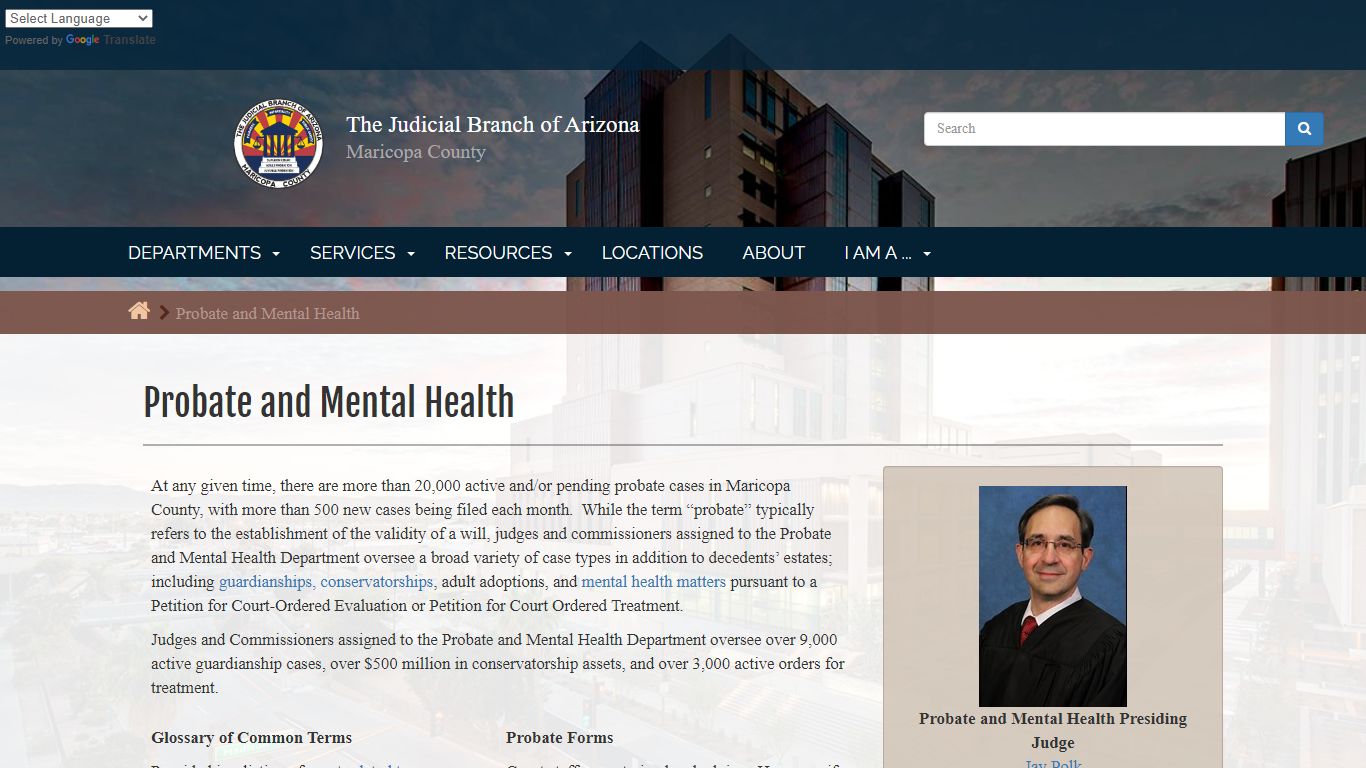
Probate Filing | Maricopa County Clerk of Superior Court
Applicants may submit probate documents in person at any of the four filing counters operated by the Clerk of the Superior Court. The downtown Phoenix office at 201 W. Jefferson Street processes filings from 08:00 a.m. to 05:00 p.m., Monday through Friday. The Southeast Mesa location at 222 E. Javelina Boulevard provides the same hours and accepts walk‑in submissions for wills, letters of administration, and petitions for conservatorship. The Northwest Regional Court Center in Surprise, located at 14264 W. Tierra Buena Lane, and the Northeast Regional Court Center at 18380 N. 40th Street, Suite 120, Phoenix, also serve the same schedule. Each site offers a self‑service kiosk for electronic filing of PDF‑formatted documents, and staff are available to guide users through the required statutory forms, such as the Uniform Probate Code‑based “Petition for Probate of Will” (Form PC‑101) and the “Account of Estate” (Form PC‑203). Fees are posted on‑site and may be paid by cash, credit card, or electronic check.
https://www.clerkofcourt.maricopa.gov/services/filings/probate-filing 
Maricopa County Probate Court – LegalConsumer.com
LegalConsumer.com connects callers to certified probate attorneys who have handled at least ten estate administrations in Phoenix between 2018 and 2023. By dialing (855) 324‑7891, clients can schedule a free 15‑minute consultation, during which the attorney will review the decedent’s assets, verify the existence of a valid will, and outline the steps required to obtain letters testamentary. The directory page also lists the official Maricopa County Probate Court website, the court’s physical address at 201 W. Jefferson Street, a Google‑derived map for parking options, and the direct phone line (602) 506‑3860 for clerk assistance. Additional links provide access to the Arizona State Bar’s probate lawyer verification tool, the county’s online docket search, and a downloadable checklist of documents needed for a smooth probate filing.
https://www.legalconsumer.com/inheritancelaw/probate.php?FIPS=04013 
Maricopa County Clerk of Superior Court | Home
The Clerk’s Office partners with local law schools, nonprofit legal aid societies, and the Arizona State Bar to offer a suite of public services. Users can retrieve case information, submit electronic subpoenas, and access an attorney‑only portal for filing discovery requests. The website also hosts a searchable database of recorded deeds, liens, and judgments dating back to 1995, enabling title companies and mortgage lenders to conduct diligence. For attorneys, a dedicated “Subpoenas Online” portal streamlines the issuance of civil and criminal subpoenas, automatically routing them to the appropriate district. The clerk’s outreach program includes quarterly webinars on recent changes to the Arizona Probate Code, such as the 2022 amendment that expands the definition of “qualified beneficiary” for small estates.
https://www.clerkofcourt.maricopa.gov/ 
Arizona Probate Forms and Resources
The Arizona Judicial Branch provides an online portal that aggregates all statutory probate forms required for estate administration, guardianship, and conservatorship. Users can download Form PC‑101 (Petition for Probate of Will), Form PC‑102 (Petition for Administration of Estate), and Form PC‑104 (Waiver of Administration) in PDF format, each accompanied by detailed instructions referencing Arizona Revised Statutes §§ 14‑1001‑14‑1034. The site also lists contact information for the Statewide Guardianship Registry, which maintains records of all active guardians in the state, and links to the Arizona Attorney General’s Senior Services Division, which oversees protection against elder abuse. In addition, the portal offers a step‑by‑step video tutorial that demonstrates how to file a small estate affidavit for assets valued under $75,000, a process introduced by the 2021 Probate Simplification Act.
https://www.azcourts.gov/probate 
Guide To Maricopa County Probate Court – JacksonWhite Law
JacksonWhite Law outlines the procedural timeline for a typical probate case in Maricopa County. First, a qualified individual—often a family member, fiduciary, or court‑appointed attorney—files a petition to be recognized as the executor or administrator of the estate. The petition must be accompanied by the original death certificate, a certified copy of the decedent’s will (if one exists), and a complete inventory of assets valued at the time of death. Once the petition is filed, the court schedules a hearing within 15 calendar days to verify the authenticity of the will and the suitability of the proposed executor. After the court issues letters testamentary or letters of administration, the executor must publish a notice of probate in an approved newspaper for at least four weeks, as required by A.R.S. § 14‑1004. The final stage involves filing an accounting of all estate transactions, obtaining court approval, and distributing the remaining assets to heirs according to the will or intestacy statutes.
https://www.jacksonwhitelaw.com/probate/maricopa-county-probate-court-guide/ 
The Judicial Branch of Arizona in Maricopa County
The Maricopa County division of the Arizona Judicial Branch operates multiple courthouses that provide civil, criminal, family, and probate services to a population exceeding four million residents. Each courthouse maintains an electronic filing (e‑File) system that logs case actions in real time, allowing parties to monitor docket entries, schedule hearings, and submit briefs electronically. The branch also runs a Community Law Access program, which partners with local libraries to offer free legal research computers and workshops on navigating the probate system. In response to COVID‑19, the courts instituted a virtual hearing platform that supports video conferencing for probate settlements, allowing parties to appear remotely while maintaining confidentiality and security. The Judicial Branch’s public‑trust initiatives include annual transparency reports that detail case volume, processing times, and budget allocations for probate services.
http://www.superiorcourts.maricopa.gov/ 
Maricopa County Superior Courts – Probate Case Search
UniCourt’s online search tool grants public access to Maricopa County probate records without charge. Users can query the database by docket number, party name, attorney, judge, or filing date. Results display the full docket entry, including initial petitions, notice filings, and final orders, and can be filtered by case type (e.g., estate administration, guardianship, small estate affidavit) or by the date range of interest. Each record includes a link to the official court PDF, the date the document was uploaded, and a summary of the case’s current status (open, closed, or pending appeal). The platform also provides alerts that notify subscribers of new entries or status changes, which is useful for beneficiaries tracking the progress of an estate or for attorneys monitoring competing claims.
https://unicourt.com/courts/state/maricopa-county-superior-courts-49/probate 
Probate Division – LA Court
Although based in California, the Los Angeles Superior Court’s Probate Division provides a model form set that is referenced by many Arizona practitioners for drafting inter‑state probate documents. The division offers standardized forms for petitions, notices, and asset inventories, all of which comply with the Uniform Probate Code adopted by Arizona in 2000. Practitioners in Maricopa County often download Form PS‑001 (Petition for Probate) and adapt it to meet Arizona’s filing requirements, such as attaching a certified copy of the decedent’s Arizona death certificate. The LA Court also maintains a searchable docket database that includes decisions on cross‑jurisdictional probate disputes, which can be cited in Arizona filings when addressing issues like concurrent probate in multiple states.
https://www.lacourt.org/division/probate/probate.aspx 
Probate Authorities and Resources – azcourts.gov
The Arizona Courts website publishes the Administrative Code of Judicial Authority (ACJA) sections that govern probate practice statewide. Section 3‑301 details the minimum standards for court facilities, judge qualifications, and case management procedures. Section 3‑302 lists the mandatory probate forms (Forms 1‑10), including the “Petition for Administration” and the “Order Approving Distribution.” Section 3‑303 establishes fee schedules, outlining the base filing fee of $150 plus per‑page charges, and provides guidance on competitive bidding for court‑appointed fiduciary services. Section 7‑202 defines fiduciary duties, referencing the Arizona Fiduciary Act and outlining reporting obligations to the Attorney General’s Seniors Division. Additional resources linked from the page include the Adult Protective Services hotline (602‑261‑3820) and the Arizona Department of Health Services’ mental health competency evaluation forms.
Contact Us
Address: 301 details the minimum standards for court
https://www.azcourts.gov/probate/Probate-Authorities-and-Resources 
Related Search Terms
Brown Co Mn Jail Roster Street Address Phone Number Lake County Common Pleas Court Records Cowlitz County Jail Roster Releases